
Created by artist Helen Yung, REPRODUCTION is a social performance and open score that reframes the experience of ART (Assisted Reproductive Technology) as creative embodied inquiry.
Description
REPRODUCTION is a social performance that weaves memories, facts, fertility rituals, and fabrication into a 15-minute performance, followed by an open-ended Long Table-style conversation that audience members are invited to participate in.
REPRODUCTION performed by Helen Yung generates a reproduction of the artist as a Happy Baby, and references systemic failures within the medical-industrial complex to ask: How is this not eugenics?
REPRODUCTION 1 was performed with the artist’s mother. It was developed with dramaturgical support from Cole Lewis, space from The Theatre Centre (Toronto), and a presentation with Movement Research at the Judson Church (New York).
Future REPRODUCTIONS performed by the artist may be performed with other guests: a bio tech artist, a reproductive endocrinologist, her sperm donor, her reproductive lawyer, queer kin, other family members, other artists, past lovers, etc.

REPRODUCTIVE Variations
REPRODUCTION is also an open score can be performed by other interpreters (people seeking assisted reproduction). Their performances will become variations.
The score consists of:
- A memory
- Four facts
- A fertility ritual
- An assisted act of reproduction
- A conversation that takes place afterward
Artists interested in performing the score and/or presenters interested in co-hosting the conversation are invited to get in touch.

Q & A
What is the audience experience?
The audience is seated around an open space, in the centre of which is a large sheet of paper. (Big enough for the artist to roll around on.) As the artist enters, we listen to an audio recording of an ultrasound appointment. In the recording, the artist is greeted by a technician and we understand that she is undergoing some kind of medical examination.
As the audio recording of the appointment continues, the artist sits down in the space and begins to palpate her stomach, alluding to the poking and prodding of the countless ultrasound appointments that make up assisted reproduction. Through sound, we see the otherwise invisible.
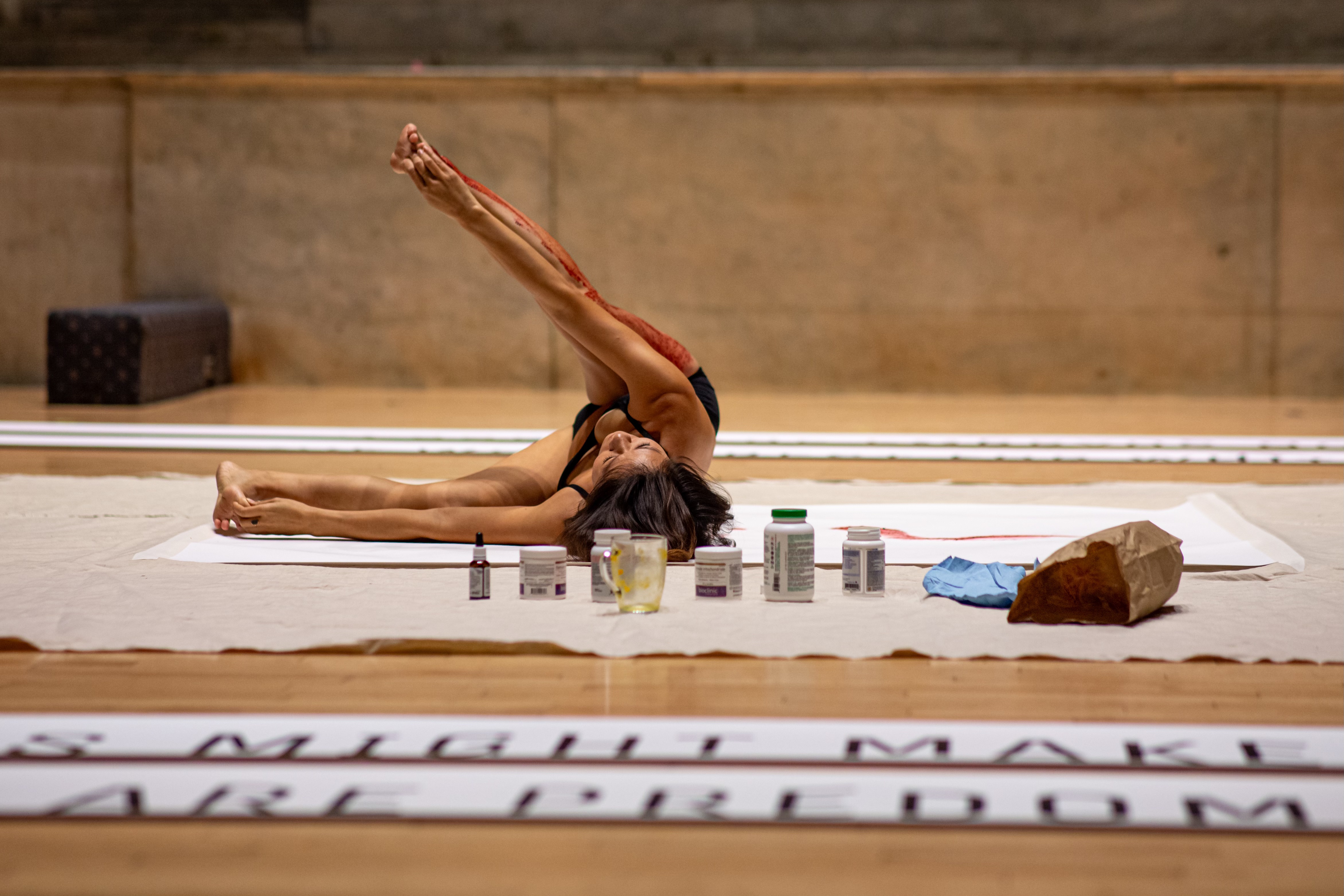
Several minutes later, the recording ends and the artist leaves that task and begins unfurling four long banners with facts printed on them:
- MY BODY MAKES EMBRYOS NOT BABIES
- IVF WORKS BEST FOR WHITE BODIES
- DONOR EGGS MIGHT MAKE ME A BABY
- DONOR EGGS ARE PREDOMINANTLY WHITE
That task completed, the artist then retrieves a glass of water and a paper bag filled with fertility supplements and medications. We watch her pop dozens of pills. If the performance has been timed to line up with a real assisted reproductive act, this is also when we witness her puncture the skin with hormone injections, or place progesterone suppositories in her vagina.
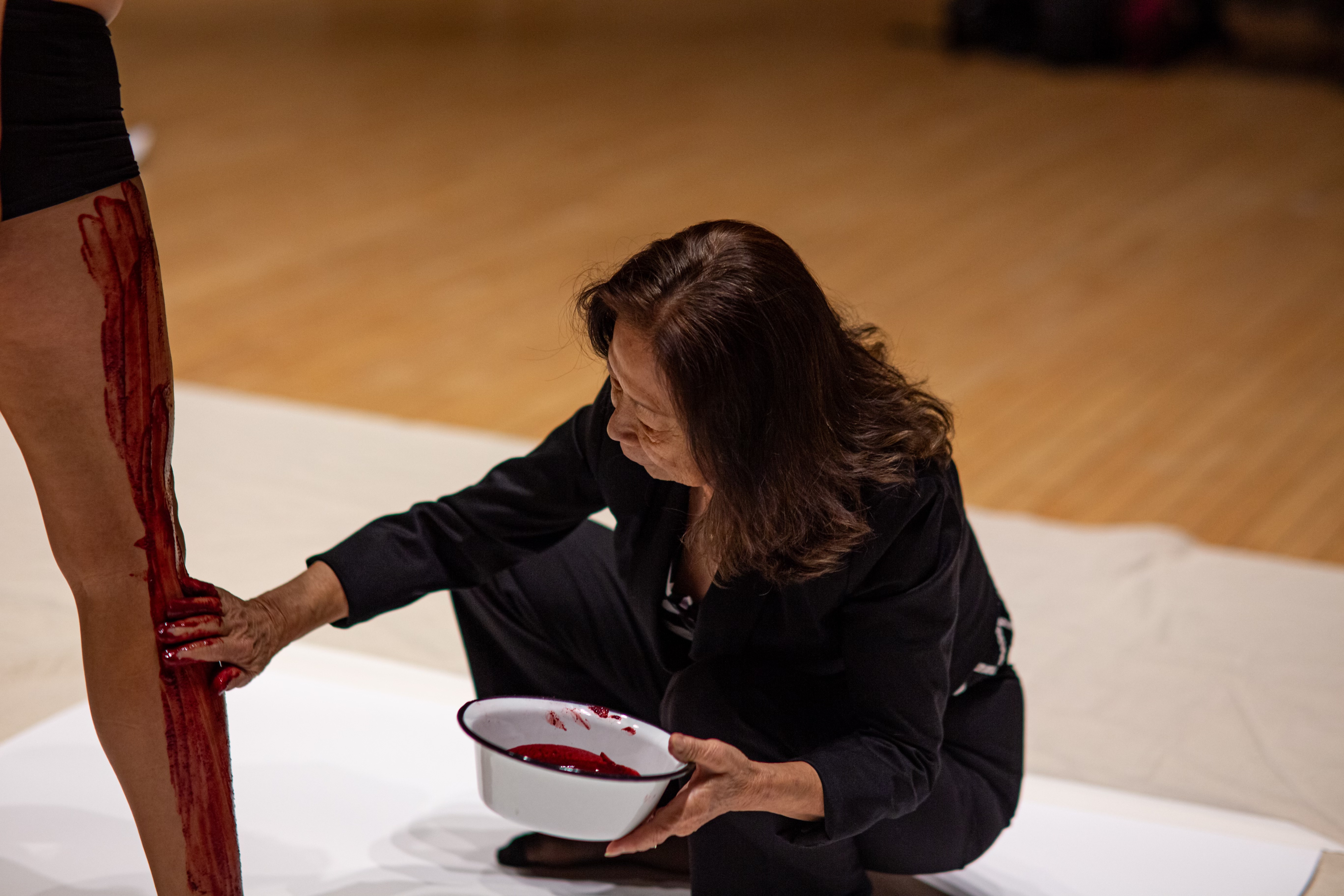
Finally, with this task completed, the artist is joined by a guest helper. The guest assists her with a full-body print (reproduction) of the artist in the yoga pose known as ‘Happy Baby.’
Following this, audiences join the artist and helper on stage to gather around this pretext for a conversation. The guest helper is invited to offer provocations to consider assisted reproduction through multiple lenses: historical, medical, material, economic, esoteric, folk, futurist, feminist, community, cultural, witchcraft, and creative.
Why is there a conversation afterwards?
As the artist was undertaking egg freezing and IVF, she discovered many people had so many questions. People with ovaries, in particular, often told her, “I’ve been thinking about doing this!” She also came across many artists who had lots to share about their experiences with infertility, miscarriages, and family formation.
The assisted reproductive process is fraught, everyone knows this, in the abstract. The specifics of what makes it a shitstorm and enraging, particularly for anyone who lives by non-normative values, are much lesser known. If we don’t talk about it, we can’t change it. We can’t make it better for those who come after us.
Are you promoting assisted reproduction?
Absolutely not. Progressives will advocate for sexual education but we shy away from reproductive education. Why? Just as sexual education doesn’t mean people will go straight out to have sex, providing reproductive education doesn’t mean people will go in droves to do something they had never wanted to do in the first place.
Why are you doing this?
For so many reasons, and also for the simple reason that I am an artist. I see, I experience, I feel, I make art. Some of the other reasons include:
- Asian people are grossly underrepresented in stories about creation and motherhood
- Assisted Reproduction is a booming industry forecasted to skyrocket. People going through and thinking about ART want to connect with others. It’s not shameful; it’s the new normal.
- Artists know a lot about creation. We can help make ART work better for all people.
Do you need a very large space?
The 4 banners are 20 feet long. But it is conceivable to do a small-scale, desktop version of the performance using hand-held signs printed with the same four facts. Potentially the reproduction would then be of the artist’s hand, rather than their full body. With adjustments like this, the performance and conversation could perhaps take place in a class or board room.

Photos by Rachel Keane. All rights reserved.
 Helen Yung